The Employment Permit System (eps go korea) allows Korean employers—who are unable to recruit local workers—to legally hire foreign employees. This system is managed by the Korean government or designated public institutions to ensure fair recruitment, protect workers’ rights, and maintain transparency.
EPS aims to balance the use of foreign labor while safeguarding employment opportunities for Korean citizens. Each year, the Korean government determines the quota for foreign worker recruitment based on the country’s economic situation and labor market needs.
Key Features of the eps go korea
- Target Employers: Businesses with fewer than 300 regular employees in industries facing labor shortages, such as agriculture, livestock, fisheries, construction, and manufacturing.
- Fair Selection: Foreign workforce recruitment is handled transparently, preventing corruption and irregularities in the sending process.
- Government-to-Government Agreements: Workers are recruited through an MOU (Memorandum of Understanding) signed between South Korea and the sending country’s government.
- Qualified Workers: Selection based on skills, work experience, and Korean language ability.
- Equal Rights: Foreign workers receive the same protection under Korean labor laws (e.g., Labor Standards Act, Minimum Wage Act, Industrial Safety and Health Act) as local employees.
Selection & Introduction Process for Foreign Workers (E-9 Visa)
- Policy Decision
The Foreign Workforce Policy Committee, under the Prime Minister’s Office, decides on quotas, business sectors, and sending countries.
- MOU Signing
South Korea signs an MOU with sending countries to ensure fair recruitment and prevent corruption. The MOU is regularly reviewed.
- Job Seeker Roster
The sending country’s government selects qualified candidates based on EPS-TOPIK scores, skills tests, and work experience. HRD Korea reviews and approves the list.
- Worker Selection & Employment Permit Issuance
If employers fail to hire Koreans despite active recruitment for 3–7 days, they may apply for an Employment Permit. Job Centers recommend qualified foreign workers up to three times. Employers then select suitable candidates, and the Ministry of Employment and Labor (MOEL) issues permits.
- Signing the Labor Contract
Employers and selected workers sign a Standard Labor Contract specifying wages, working hours, holidays, and workplace details.
- Visa Confirmation Certificate
Employers apply to the Ministry of Justice (MOJ) for a Certificate for Confirmation of Visa Issuance (CCVI).
- Worker Entry
Employers send the CCVI to the sending country. Workers apply for an E-9 visa at the Korean Embassy, enter South Korea, and complete at least 16 hours of employment training.
- Employment & Sojourn Management
- MOEL: Conducts labor inspections and offers post-employment support such as consultations and free education.
- MOJ: Manages immigration status and ensures compliance through linked systems with MOEL.
Workers may change workplaces only for valid reasons, such as business closure or unpaid wages.
South Korea Lottery Registration 2025 Has Been Published Recently
EPS-TOPIK Overview
The EPS-TOPIK (Test of Proficiency in Korean for EPS) is required for most applicants.
- Structure: Listening (20 questions) + Reading (20 questions)
- Duration: 50 minutes (25 minutes per section)
Content: Basic Korean language, understanding of Korean society, job responsibilities, and industrial safety.
Web Links – Web links for information
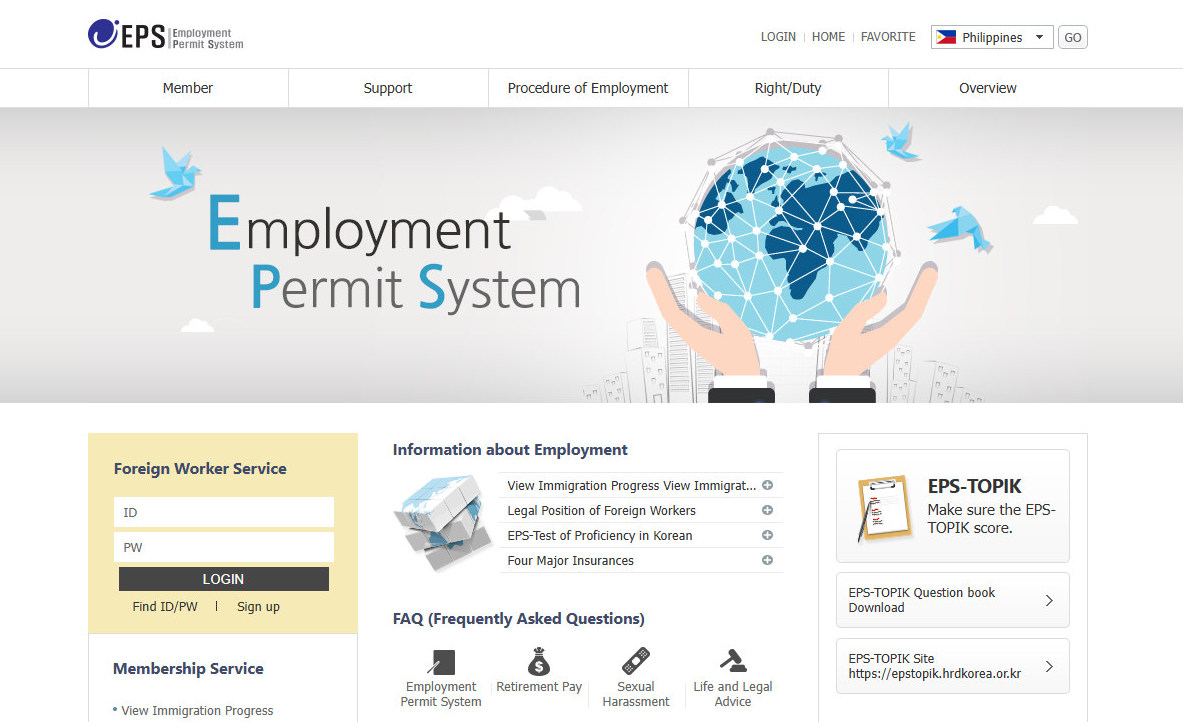
- EPS : https://www.eps.go.kr/
- HRD Korea & EPS TOPIK : http://eps.hrdkorea.or.kr/
Conclusion
The Employment Permit System (eps go korea) offers a transparent and fair process for hiring foreign workers while protecting job opportunities for Koreans. By managing recruitment through government agreements, ensuring equal labor rights, and selecting qualified candidates, EPS supports industries facing labor shortages. With proper training, fair contracts, and strict oversight, the system benefits both employers and workers, contributing to South Korea’s economic growth and promoting safe, ethical, and sustainable employment practices.